With the increasingly widespread application of plastics, the environmental pollution pressure caused by waste plastics is also rising. Restricting the use of traditional plastics and developing degradable plastics have gradually attracted the attention of governments and society.
Since the state issued the policy of "levying fees on plastic shopping bags" in 2008, remarkable improvements have been achieved in some regions. Twelve years later, starting from the beginning of this year, a series of plastic restriction and prohibition policies have been rolled out frequently. Many regions have stipulated: a comprehensive ban on the production and sale of certain plastic products; promotion of green plastic products; exploration of new business formats; standardization of the recycling and disposal of plastic waste; and special treatment of plastic garbage.
For a long time, China has been a major global producer and consumer of plastics. According to Quantuo Data, the total output of plastic products in China reached 81.8417 million tons in 2019, with a demand of 68.0538 million tons. Its huge scale is evident from the consumption of plastic bags alone—about 3 billion plastic bags are used in China every day, and by 2019, the annual consumption of plastic bags exceeded 4 million tons.
The market size of China's plastic packaging industry stood at 49.64 billion US dollars in 2017, and it was estimated to reach 56.4 billion US dollars in 2020, with a projected compound annual growth rate (CAGR) of 4.4% by 2025.
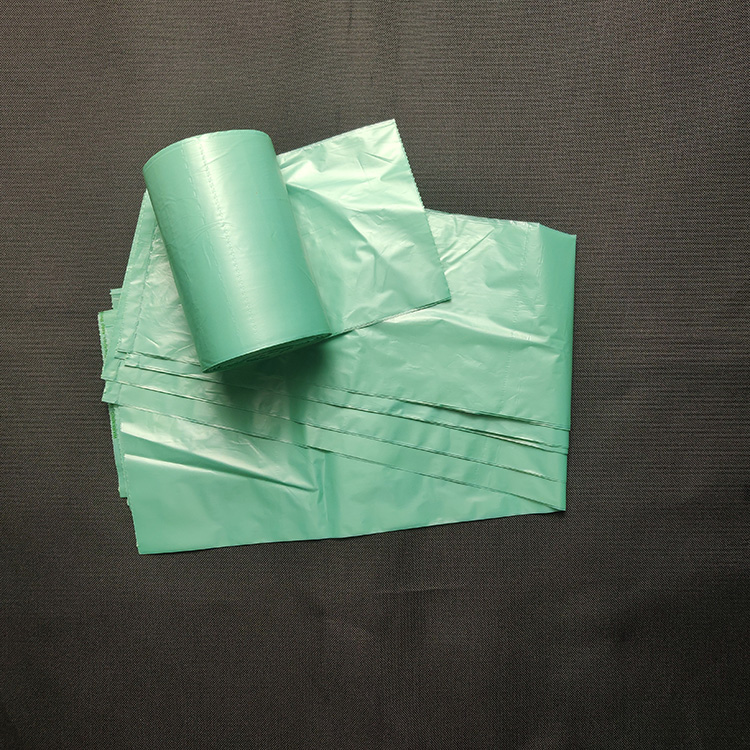 Compostable Degradable Roll Bags
Plastic products have brought great convenience to people's lives, but the environmental problems caused by improper disposal of a large number of used plastic products have become a global focus. Currently, the global output of single-use plastic products alone reaches 120 million tons every year. Only 10% of them are recycled, another 12% are incinerated, and more than 70% are discarded into soil, air and oceans.
At present, various regions are striving to promote the implementation of the "new plastic restriction policy". Most provinces including Hainan, Hebei, Guangdong, Shandong, Henan, Zhejiang and Tianjin have successively issued implementation plans for plastic pollution control, all listing degradable plastic products as alternative products for popularization and application. "The plastic ban is not about prohibiting the entire plastic industry, but about replacing and improving some non-degradable materials with degradable ones," professionals noted. Bio-based materials with degradable functions, represented by polylactic acid (PLA) made from corn and straw, have quickly gained public attention.
Under the requirements of the plastic ban, non-degradable plastic products in some key regions are being phased out gradually. Once these plastic products withdraw from the market, they will leave a huge market gap for alternatives. At present, the market penetration rate of degradable plastics in China is low. In 2018, China's plastic consumption reached 109 million tons, while the market demand for degradable plastics was only 42,000 tons, with a penetration rate of about 0.04%. The degradable plastic industry still has enormous room for development.
The demand for degradable plastics is mainly concentrated in packaging fields such as plastic bags, food containers, agricultural mulch films and express delivery packaging. From the perspective of the global demand structure for degradable plastics in 2019, the packaging sector accounted for 53% of the total demand, among which flexible packaging accounted for 31% and rigid packaging for 22%. In addition, sectors like textiles, agriculture and consumer goods also hold a relatively large share.
However, in this process of "replacing the old with the new", user experience cannot be ignored. Take the recent popular "milk tea paper straw replacement" as an example. Many netizens pointed out on social media platforms that paper straws tend to become soft and collapse during use, with insufficient suction power. They not only deprive users of the "fun" of biting straws, but some paper straws used in individual stores have a strong paper smell, affecting the taste of drinks. Keywords such as "correct usage of paper straws" even made it to Weibo's trending topics.
Although the degradable plastic industry has been developing in China for more than 20 years, it has not been able to be promoted on a large scale. Degradable plastic products have long been plagued by problems such as insufficient production capacity, high costs and poor processability, with the global production capacity only at the million-ton level. Since 2020, nearly 2,300 new enterprises related to degradable materials have been established, a year-on-year increase of 38% compared with 2019. In the long run, the degradable plastic market still has great potential.
Sayru Technology holds the view that previously, the market supply and demand scale of degradable plastics was relatively small, and the plastic ban has brought golden development opportunities to the degradable materials industry. Faced with the sudden surge in market demand, the key for enterprises in the industry to seize opportunities and stand out lies in launching new eco-friendly products that are both practical and cost-effective, integrating environmental protection and public benefits, and building a supply chain for degradable products. Those who can do so will occupy the market with more affordable and eco-friendly products.
Article Title: Degradable Plastics Emerge as a Blue Ocean Under the Plastic Ban URL: https://en.szxylp.com/news/industry-news/degradable-plastics-emerge-as-a-blue-ocean-under-the-plastic-ban.html