Environmentally Friendly Degradable Bags, as the name suggests, are bags that do not pollute the environment and can be degraded. Currently, they mainly refer to biodegradable bags, namely polylactic acid (PLA) biodegradable bags. Today, we will focus on the degradation raw materials and required conditions for polylactic acid biodegradable bags.
Environmentally friendly degradable bags do not decompose easily. Like natural biodegradable polymers such as cotton and silk, they will not decompose during use. Cotton and silk products generally start to biodegrade (mold) from dirty areas when stored deep in cabinets in midsummer. In other words, the initiation of biodegradation requires a high-temperature, high-humidity environment and microbial nutrient sources—and the same applies to environmentally friendly degradable bags. Since most introductions describe them as "plastics that can be reduced in soil," consumers often complain that "they were buried in the yard but did not decompose" or "put into household composters but failed to decompose." Failure to decompose or slow decomposition is inevitably due to the lack of one or more of the three essential factors: high temperature, high humidity, and nutrient sources.
As mentioned above, the decomposition of environmentally friendly degradable bags is greatly affected by temperature and humidity. At room temperature (25℃), hydrolysis begins after six months, and biodegradation starts after nearly a year. In the initial stage of decomposition, microorganisms play almost no role—this is an important characteristic of environmentally friendly degradable bags.
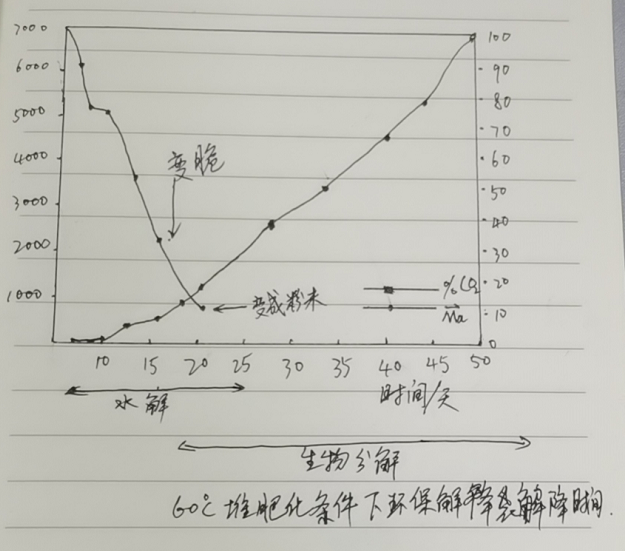
However, decomposition proceeds rapidly in a high-temperature (60℃~70℃) and high-humidity (50%~60%) environment such as compost. As shown in the figure, the average molecular weight of the environmentally friendly degradable bag is 100,000. When the molecular weight drops to 20,000, the bag becomes brittle; when it reaches 10,000, it turns into powder. Meanwhile, it begins to biodegrade into lactic acid and lactic acid oligomers, releasing carbon dioxide. This two-stage decomposition mechanism is a distinguishing feature of environmentally friendly degradable bags. Therefore, the best disposal method for environmentally friendly degradable bag products is composting.
Article Title: Decomposition Principle of Environmentally Friendly Degradable Bags - How Do Degradable Bags Degrade? URL: https://en.szxylp.com/news/company-news/decomposition-principle-of-environmentally-friendly-degradable-bags-how-do-degradable-bags-degrade.html